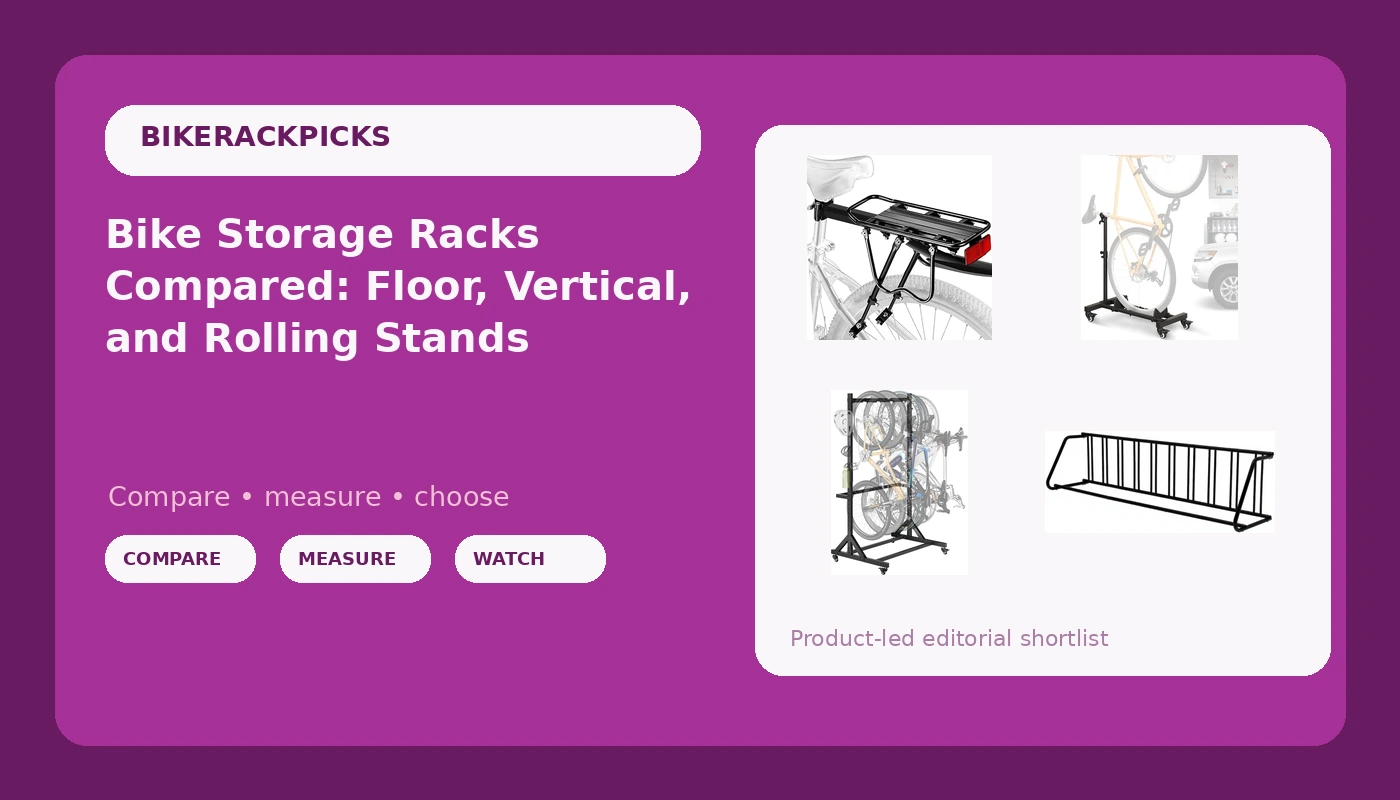
Where a bike sleeps decides whether it gets ridden tomorrow. A bike that has to be lifted over a lawn mower, threaded past a car door, or leaned against finished drywall tends to stay parked, and the ride you promised yourself after work quietly does not happen. A bike storage rack removes that friction, and it also protects what you paid for: derailleurs, rotors, and carbon tubes do not enjoy being stacked against each other in a pile.
This guide covers four different answers to the same problem. Two are freestanding racks for a garage or apartment, one is a floor-mounted steel grid for a fleet of bikes, and one is a rear cargo rack that mounts on the bicycle itself. That last one is a different job that gets confused with storage constantly. The right bike storage rack depends on how many bikes you own, how much floor you are willing to surrender, and whether the rack needs to move or stay put.
Related: Hitch Rack Sizing: What a 1.25-Inch Receiver Really Limits →
Quick answer
Start with the bike count and the ceiling. One or two bikes in a tight space point toward a vertical stand that holds a bike upright on a small footprint. Three to five bikes point toward a freestanding rack on casters, so the whole stack can roll out of the way. Six or more bikes, or a shared space such as an apartment bike room, a school yard, or an event staging area, point toward a floor-mounted steel grid. If your real goal is carrying panniers and groceries on the bike rather than parking it, you want a rear cargo rack, and that belongs on the bicycle, not on the garage floor.
Four useful options
| Model | Best fit | What stands out |
|---|---|---|
| Vertical Bike Stand, Freestanding Bike Rack for Garage Storage, Upright Bicycle Floor Stand with Adjustable Height and 360° Rolling Wheels, Space Saving Indoor Bike Holder for 24"-29" Standard Bikes | One bike in a small apartment or a single garage bay | Adjustable height, 360° rolling wheels, listed for 24" to 29" standard bikes |
| monTEK Freestanding Bike Storage Rack with Wheels for 5 Bikes | A household with several bikes sharing a garage with a car | Freestanding frame on wheels with capacity for five bikes |
| Heavy Duty 10-Bike Floor Bike Rack, 122" Length All-Steel Grid Bike Rack, 10-Bike Capacity Single-Sided Storage Stand with Floor Mount Kit for Garages Streets Apartment School Yards Bike Events | Bike rooms, schools, apartment storage, event parking | 122-inch single-sided all-steel grid, 10-bike capacity, floor mount kit included |
| Rear Bike Rack,Bike Cargo Rack w/Fender & Large Size Reflective,Quick Release Mountain Road Bicycle Rear Racks,Universal Bike Luggage Rack,Large Capacity Bike Pannier Rack,YONTUO | Commuters and touring riders carrying bags on the bike | Quick release mounting, integrated fender, large reflective, pannier capacity |
Single-bike space saver: Vertical Bike Stand
Vertical storage trades lifting effort for floor space, and that is the whole bargain. Standing a bike on its rear wheel or hanging it nose-up frees the footprint a horizontal bike would occupy, which matters in a one-car garage or a hallway closet. The trade-off is that you have to lift the bike every time, so a heavy e-bike or a step-through frame can be awkward to seat correctly. Check your ceiling before you commit, and check that the cradle or hook is sized for your tire and wheel, since a stand listed for 24" to 29" bikes is aimed at standard wheels rather than 20-inch kids bikes or fat tires.
Mid-capacity storage: monTEK Freestanding Bike Storage Rack with Wheels for 5 Bikes
Five bikes is where storage stops being a corner problem and becomes a layout problem. A rack this size occupies a real rectangle of floor once it is loaded, and the bikes themselves stick out past the frame, so measure the loaded depth, not just the rack's footprint. Wheels help most when the floor is smooth concrete or sealed epoxy; on a cracked slab or a gravel shed floor, casters can dig in. Freestanding racks also tend to be lighter than anchored steel, which is convenient until someone leans on a loaded one, so keep the center of gravity in mind and consider where the handlebars will land relative to a car door.
Fleet storage: Heavy Duty 10-Bike Floor Bike Rack
This is the category of rack you see in apartment bike rooms, school yards, and event corrals. A 122-inch single-sided grid holds bikes in a row, wheel engaged in the grid, which means loading and unloading is quick and does not require lifting a frame above your shoulders. The trade-offs are permanence and space: the floor mount kit implies anchoring, and a ten-bike row needs a wall long enough to host it plus clearance to walk the row. It is also not a rack you move for spring cleaning. If your bikes vary in tire width, check how the grid engages the front wheel, because a very narrow road tire and a wide gravel tire do not sit the same way in a fixed cradle.
On-bike cargo: Rear Bike Rack, Bike Cargo Rack with Fender and Reflective
It is worth being blunt here: this is not a storage rack, and buying it to solve a garage problem will disappoint you. It attaches to the bike and travels with it, which makes it the right answer for commuting, errands, and light touring where the alternative is a sweaty backpack. The considerations are different from a floor rack: mounting hardware has to suit your frame and axle type, a loaded rack changes how the bike handles, and weight should stay low and balanced rather than stacked high. Check that the rack clears your brake calipers and that your frame has the mounting points the design expects, since "universal" in a listing title rarely means universal across every frame.
Prices and availability may change. Product images, names, and retailer links are matched to verified listings. No current price, rating, stock status, or measured result is stated here without current evidence.
How storage racks and cargo racks differ
The four options above split into two families, and mixing them up is the most common mistake in this category. Storage racks hold a stationary bike: they engage a wheel, a frame, or a hook, and their job is to keep bicycles upright, separated, and off the floor. Cargo racks hold luggage on a moving bike: they bolt to the frame or seatpost, carry weight over the rear wheel, and are judged by mounting security, heel clearance, and how the load affects steering.
Within storage, three variables do most of the work. Footprint is the floor area the rack occupies when loaded, which is always larger than the rack itself because bikes stick out. Capacity is how many bikes it holds, and it usually scales with length rather than height, so a five-bike rack is roughly five bikes wide. Mounting method decides whether the rack can move: freestanding racks sit on the floor and often ride on casters, while grid racks and wall systems are anchored and stay where you put them.
Vertical storage is a fourth variable, and it is really a space trick. Standing a bike up converts a long footprint into a tall one, which is excellent in a narrow bay and useless under a low ceiling or in a room where you cannot lift a 25-pound bike overhead. The racks listed here that use wheels or a freestanding base all assume you have floor space to give; the vertical stand assumes you have height instead.
How to size a rack to your space
- Count the bikes you actually store indoors, not the bikes you own. A bike that lives on a trainer or in a shed does not need a slot.
- Measure the longest wall you can dedicate, then subtract walking clearance at both ends. A 122-inch grid rack needs more than 122 inches of usable room.
- Measure your ceiling if you are considering vertical storage. A bike stood upright adds roughly its own length to its height, and you still need room to lift it into place.
- Check the tire and wheel sizes of every bike in the household against the rack's stated range. Kids bikes, fat bikes, and 700c road wheels do not share the same cradle.
- Decide whether the rack moves or stays. If you park a car in the same bay, choose casters and a footprint you can slide aside; if the rack is going in a shared room, choose anchoring.
Practical guidance
- Measure loaded depth, not rack depth. Handlebars and pedals add inches that a product page rarely mentions.
- Match the rack to the surface. Casters roll on smooth concrete and fight gravel, cracked slabs, and deep-pile carpet.
- Anchor anything that holds more than a few bikes. A floor mount kit exists because a tall loaded rack can tip if someone leans on it.
- Keep indoor racks indoors. Steel and powder coat survive garages, but a rack left in weather will show it, and most of these designs are described as indoor storage.
- Do not use a rear cargo rack as a storage stand. Loaded panniers and a kickstand are not a parking solution, and a bike leaning on a loaded rack is a tip-over waiting to happen.
Which option should you choose?
Choose the Vertical Bike Stand, Freestanding Bike Rack for Garage Storage, Upright Bicycle Floor Stand with Adjustable Height and 360° Rolling Wheels, Space Saving Indoor Bike Holder for 24"-29" Standard Bikes when you have one or two standard bikes and more height than floor. Choose the monTEK Freestanding Bike Storage Rack with Wheels for 5 Bikes when a household shares one garage bay and the rack needs to roll out of the way. Choose the Heavy Duty 10-Bike Floor Bike Rack, 122" Length All-Steel Grid Bike Rack, 10-Bike Capacity Single-Sided Storage Stand with Floor Mount Kit for Garages Streets Apartment School Yards Bike Events when you are equipping a bike room, a school, or an event space where a permanent row is the point. Choose the Rear Bike Rack,Bike Cargo Rack w/Fender & Large Size Reflective,Quick Release Mountain Road Bicycle Rear Racks,Universal Bike Luggage Rack,Large Capacity Bike Pannier Rack,YONTUO when the problem is carrying gear on the ride rather than parking bikes at home.
A caveat on evidence: the details above come from the product listings, not from independent measurement. Capacity figures, wheel-size ranges, and mounting descriptions are manufacturer claims, and a rack that holds ten bikes on paper still needs a wall long enough to host it. Verify the current listing, the mounting hardware, and your own frame or wheel dimensions before you buy.
The bottom line
Bike storage is a floor-plan problem before it is a product problem. Count the bikes, measure the wall and the ceiling, decide whether the rack moves, and the category picks itself: a vertical stand for one bike in a tight bay, a freestanding five-bike rack on casters for a family garage, an anchored steel grid for a shared room, and a rear cargo rack for the rider who needs to carry things rather than park them. Whichever you choose, check current Amazon price against the listing details and confirm the wheel sizes and mounting method match what you actually ride.