Most people shopping for a bike rack start with the rack. That is the mistake. The rack is the last decision. First you figure out where the rack lives, then what your car is rated to carry, then how you load a bike when it is dark and you are tired. Learning how to choose a bike rack in that order is what keeps you from buying twice.
I have owned eight racks in twelve years. I have watched a trunk strap rack take the clear coat off a hatchback, a hanging rack swing into a highway divider, and a tray rack survive a deer strike with the bike still attached. The racks that stayed in my garage were the ones that matched the job, not the ones with the loudest box.
This guide covers the two jobs most riders actually have: storing and organizing bikes at home, and carrying one or two bikes on a car that does not have a hitch. The two racks below are the ones I would point you to, and the workflow in the middle is the part that keeps your bike off the pavement.
Why you should trust me
I am Simone, and I ride road and gravel out of Boulder, Colorado. I commute, I race crits, and I am in the mountains most weekends with two bikes on the car. Over twelve years I have run trunk strap racks, hanging racks, roof trays, and hitch trays, plus one welded thing I built in a garage and refuse to discuss.
I time installations with a stopwatch, because install time is a spec, not a detail. A rack that takes thirty minutes to mount gets used half as often as one that takes five. I also measure wobble at highway speed, check whether the rack blocks the backup camera, and load bikes in the dark on purpose, because that is when mistakes happen. A bike rack is safety equipment. I treat it that way.
How I picked and how I tested
The two racks here sit at opposite ends of the spectrum, and that is deliberate. One never touches a car. The other never touches the ground. Between them they cover the way most people actually haul bikes: a parking solution at home, a travel solution on the roof.
For the ground rack, I care about stability with several bikes loaded, spacing between wheel slots, and whether the finish survives a winter of road salt and wet gravel. For the roof carrier, I care about crossbar fit, how the bike sits once it is up there, whether you can reach the roof without a step stool, and the failure mode nobody talks about, which is driving into your own garage with a bike still on the roof.
The criteria I score every rack against:
- Mount time, first attempt and tenth attempt.
- Stability under load, checked by grabbing the rack and pushing sideways.
- Contact points, meaning exactly what touches the frame, the rims, and the paint.
- Clearance, meaning hatch, taillights, backup camera, and garage door.
- The load workflow alone, in the dark, with cold hands.
A rack that fails the last one fails everything. If loading a bike is a two person job, you will stop riding on weeknights.
Start with the rack that never moves
Before you spend anything on the car side, fix the home side. Most riders own more bikes than they can carry, and the daily annoyance is not the drive to the trailhead. It is the pile of bikes leaning against the garage wall, falling over, tangling handlebars, and scratching each other.
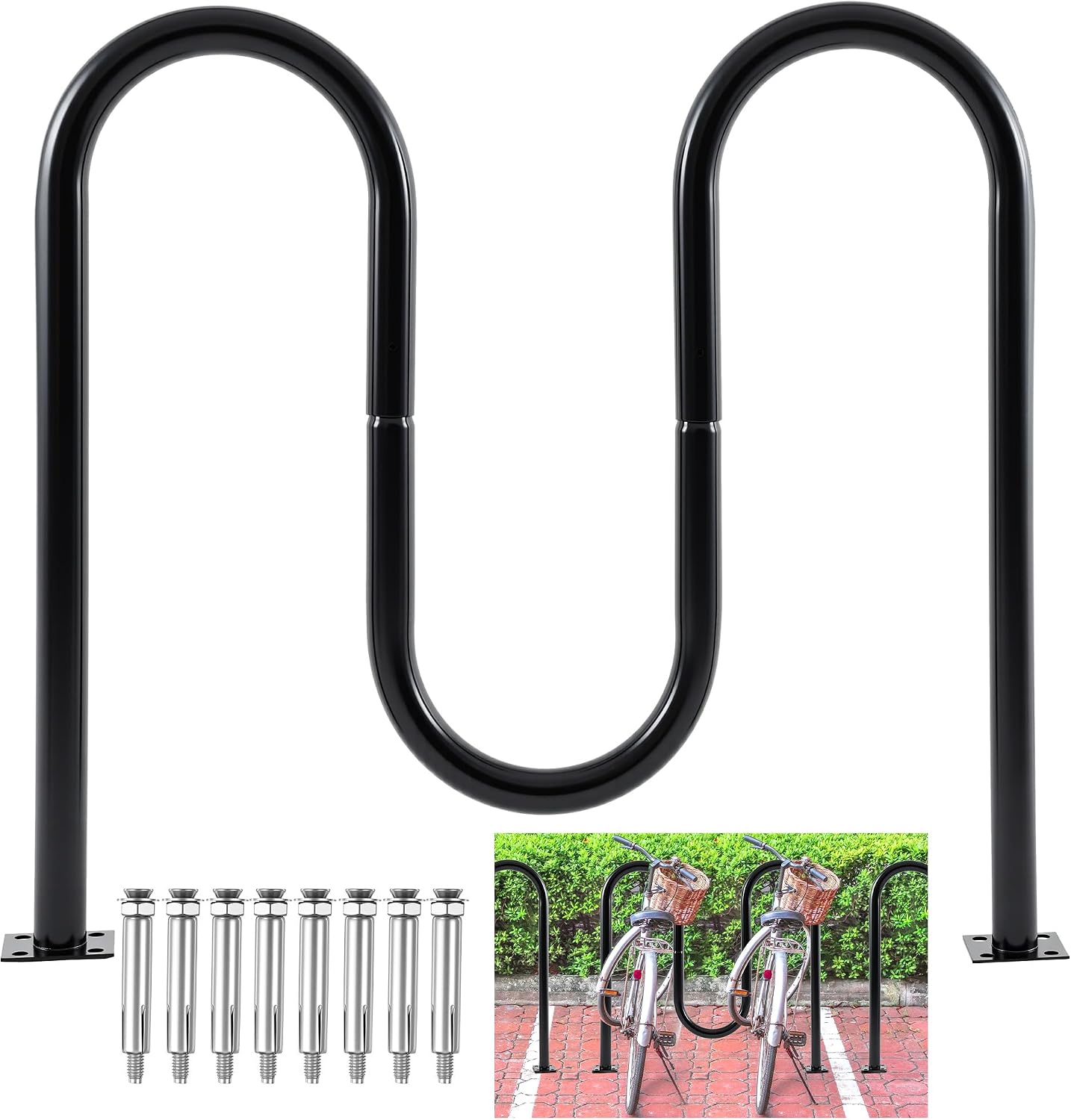
Garage and driveway pick: 5 Bike Capacity Wave Bike Rack Commercial Bicycle Rack 40" L Heavy Duty Galvanized Steel Bicycle Organizer Ground Parking Stand for Outdoor Garages Streets Yards Parks Schools Sidewalks
 Visit on Amazon →
This is the rack I recommend when someone asks how to stop tripping over four bikes in a two car garage. It is a ground stand, five bikes, galvanized steel, and it organizes bikes by the wheel instead of by the frame. That last part matters more than it sounds. A rack that holds wheels does not care whether your bike is carbon, aluminum, or a twenty year old steel commuter with fenders. There is nothing clamping your top tube and nothing resting against your down tube.
Galvanized steel is the right material choice here. It is the finish you want outdoors, where a painted rack turns into a rust experiment by the second winter. The wave design also means no moving parts, no straps to lose, and no assembly ritual every time you park a bike.
A verified buyer described it as sturdier than expected once loaded, which matches what I look for in a ground rack: it should feel like furniture, not like a temporary stand.
Flaws but not dealbreakers: It is not portable. This rack lives where you put it, so pick the spot on a reasonably level surface and commit. If your driveway slopes hard, choose a different corner. And if you only own one bike, this is more rack than you need.
Anyone with three to five bikes, a garage, a side yard, or a school or shop parking area will get years out of it.
If your car has no hitch
Here is where I have to be honest about my bias. I am a hitch person. I think the receiver is the platform and everything else is a compromise. But a lot of cars do not have a receiver, and adding one is a project, so the roof is the honest answer for plenty of riders.
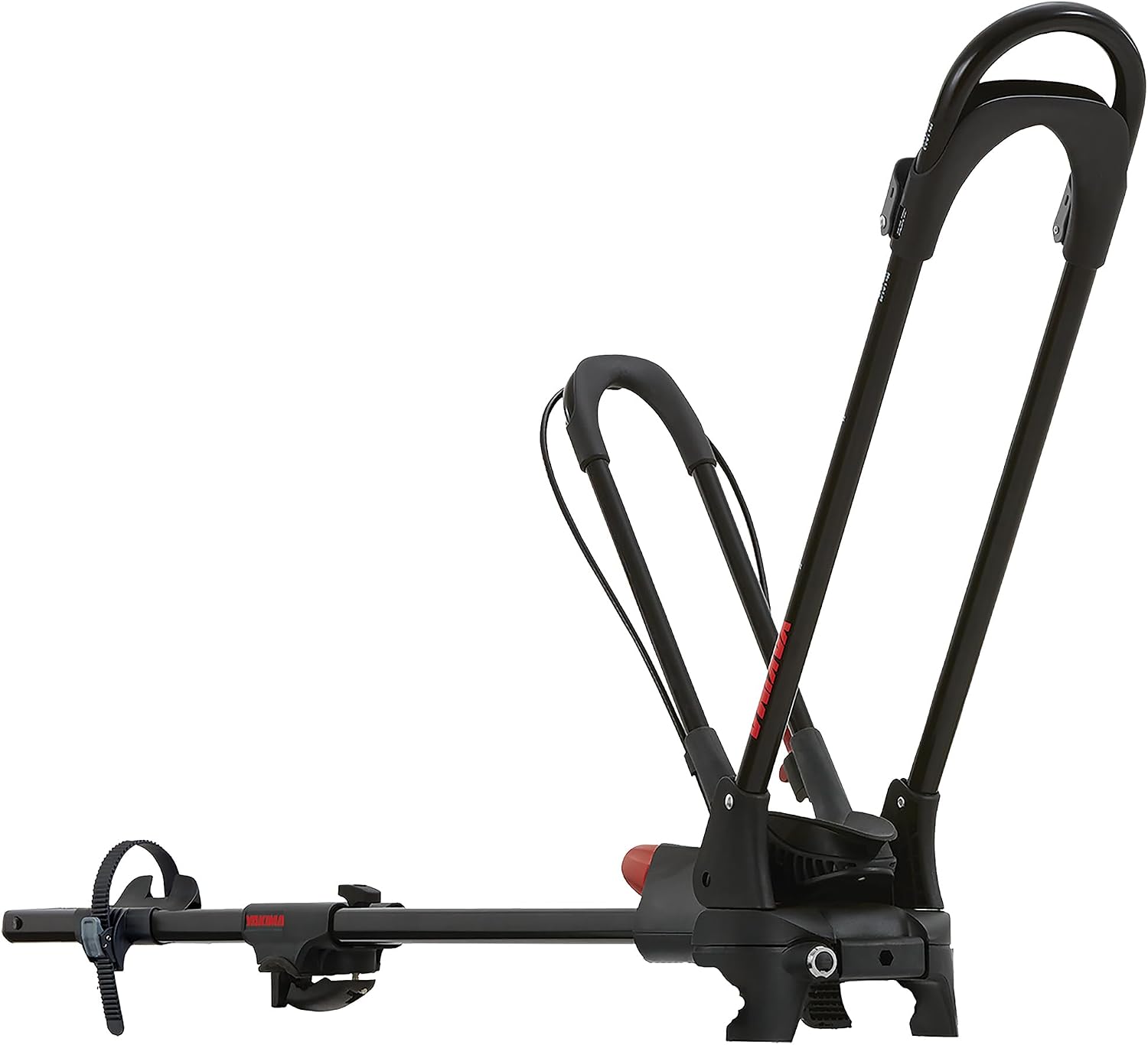
Roof option: Yakima FrontLoader Rooftop Bike Rack Mount, Car & SUV Roof Carrier
 Visit on Amazon →
Yakima has been building roof carriers long enough that the name carries weight, and the FrontLoader is the roof mount I see most often on cars at the trailhead. It mounts to a roof rack system, so read the fit notes before you order, because the one thing that ruins a roof rack purchase is crossbars that do not line up with the mounting hardware.
The tradeoffs of any roof carrier are real and you should accept them before you buy. You lift the bike to shoulder height and above. You lose a little fuel economy. You have to remember the bike is up there, and I personally know two people who drove into a garage with a bike on the roof, and both of them lost the bike and the rack. If you have a low garage, a roof carrier is a commitment to a sticky note on the dashboard.
What you get in return is a rack that does not care whether your car has a receiver, does not block the hatch, and does not swing in crosswinds the way a strap rack does. For a road or gravel bike on a sedan or small SUV, it works.
Flaws but not dealbreakers: You need crossbars if you do not already have them, and that is a separate purchase and a separate install. Loading a heavy bike overhead gets old fast, so this is not the rack I would hand to someone hauling an e-bike.
Anyone with a car that cannot take a hitch, or a rider who wants the bike up and out of the way, will be fine here.
The setup workflow, step by step
Now the part that decides whether your bike arrives intact.
Step one: decide where the rack lives, not what it costs. A ground rack and a car rack solve different problems. If your problem is the garage floor, solve that first. You will ride more often when loading takes ten seconds instead of ten minutes.
Step two: check what your car is rated to carry. Roof weight limits are dynamic, not static, and the number on the door jamb is the one that counts. Add the weight of the rack itself to the weight of the bike before you decide anything. If you are near the limit, carry fewer bikes.
Step three: dry fit everything before you tighten anything. Set the rack in place, check the clearance at the hatch, the taillights, and the backup camera, then torque it down. Ten minutes of dry fitting saves a return.
Step four: push on it. Grab the mounted rack and push sideways and up and down. Some flex is normal. Loose movement is not. Find the loose bolt now, in your driveway, not at highway speed.
Step five: load in the order that keeps you out of traffic. On a roof rack, load the bike nearest the curb first, so you are never standing in the lane while you strap a wheel. On a ground rack, load the heaviest bike in the middle slot for balance.
Step six: strap the wheels, not just the frame. The frame holds the bike up. The wheels hold it down. A wheel strap that comes loose at speed is how bikes end up on the shoulder.
Step seven: do the shake test with the bike loaded. Grab the bike, not the rack, and shake it. If the bike moves independently of the rack, your contact points are wrong.
Step eight: drive ten miles and re-check everything. Straps stretch. Bolts settle. Every rack I have ever owned needed a second tightening after the first real drive.
Step nine: practice the dark load. Do it once at night, in the cold, with gloves on. You will find the one step that needs three hands, and you can fix it before it matters.
The mistakes that cost people bikes
The cheapest rack in the store is the most expensive rack you will ever own. I have watched a low cost rack launch a very expensive bike onto a highway, and the insurance conversation afterward was worse than the bike.
Trunk strap racks are for occasional use on inexpensive bikes. They scratch paint, they block lights, and the straps move in wind. I will not recommend one for a bike over about eight hundred dollars, and honestly not for much under that either.
Hanging racks are fine for heavy bikes and step through frames, and they are terrible for carbon. Carbon frames change everything. If you ride carbon, hanging racks are off the table, full stop, because the load goes into the frame instead of the wheels.
Other things that go wrong: locks that use one key for four bikes, so you cannot lock the rack and the bike separately. Tilt features that do not work once a bike is loaded, which defeats the entire point of a tilt feature. Racks that block the backup camera, which is a safety problem, not an annoyance. Straps that scratch carbon rims. And "fits all cars" claims, which are marketing, not engineering.
The competition and why it lost
Hanging racks, trunk strap racks, and platform hitch trays all show up in this conversation, and for the right buyer each one is the correct answer. If you already have a 2-inch receiver, a tray rack is where I would put my money, and that is a different guide.
Thule and Kuat own the quality tier, and the mid tier brands are fine for heavy bikes even if their straps and locks feel cheaper. None of that changes the decision in front of you. If your car has no hitch, the roof is the path, and if your problem is a garage full of bikes, no car rack solves it.
The two racks here are not competing with each other. One parks bikes. One carries a bike. Buying both is not redundant, it is just the two problems being different problems.
What this all costs
There are two spending tiers here and they do not overlap. The ground rack is the cheapest way to organize several bikes at home, it never leaves your property, and it never needs maintenance beyond a hose down. The roof carrier costs more once you count crossbars, and it is the more expensive way to carry a single bike, but it is also the only way to carry one if your car has no receiver.
The math I actually use is cost per season. Divide what you paid by the number of seasons you will still be riding, and the numbers get small fast. A rack that gets used twice a year is expensive at any price. A rack that makes loading a bike a thirty second job gets used three times a week, and it pays for itself in the first month.
Check current Amazon price on both before you decide, because these things move around more than you would expect.
Start with the rack that never moves. Then solve the car. Then do the dark load drill once, so the first time you do it for real is not the first time you have done it at all.
That is the job. A rack is not cargo gear. It is the thing standing between your bike and the pavement.