Most bike rack purchases go wrong for the same reason: the rack gets picked for the bike instead of for the car, the garage, or the parking spot. A rider with a 1.25-inch receiver buys a heavy two-bike platform meant for a 2-inch hitch and then fights sway all summer. A household with four bikes and a one-car garage buys a hitch rack, then has nowhere to put the bikes on the days the car is gone. The bike rack storage options below cover three genuinely different jobs: keeping bikes upright at home, carrying them on a car, and adding cargo capacity to the bike itself. Figuring out which job you are solving takes a few minutes and prevents a return shipment.
Related: Hitch Rack Wobble: What Causes It and How to Fix It →
Quick answer
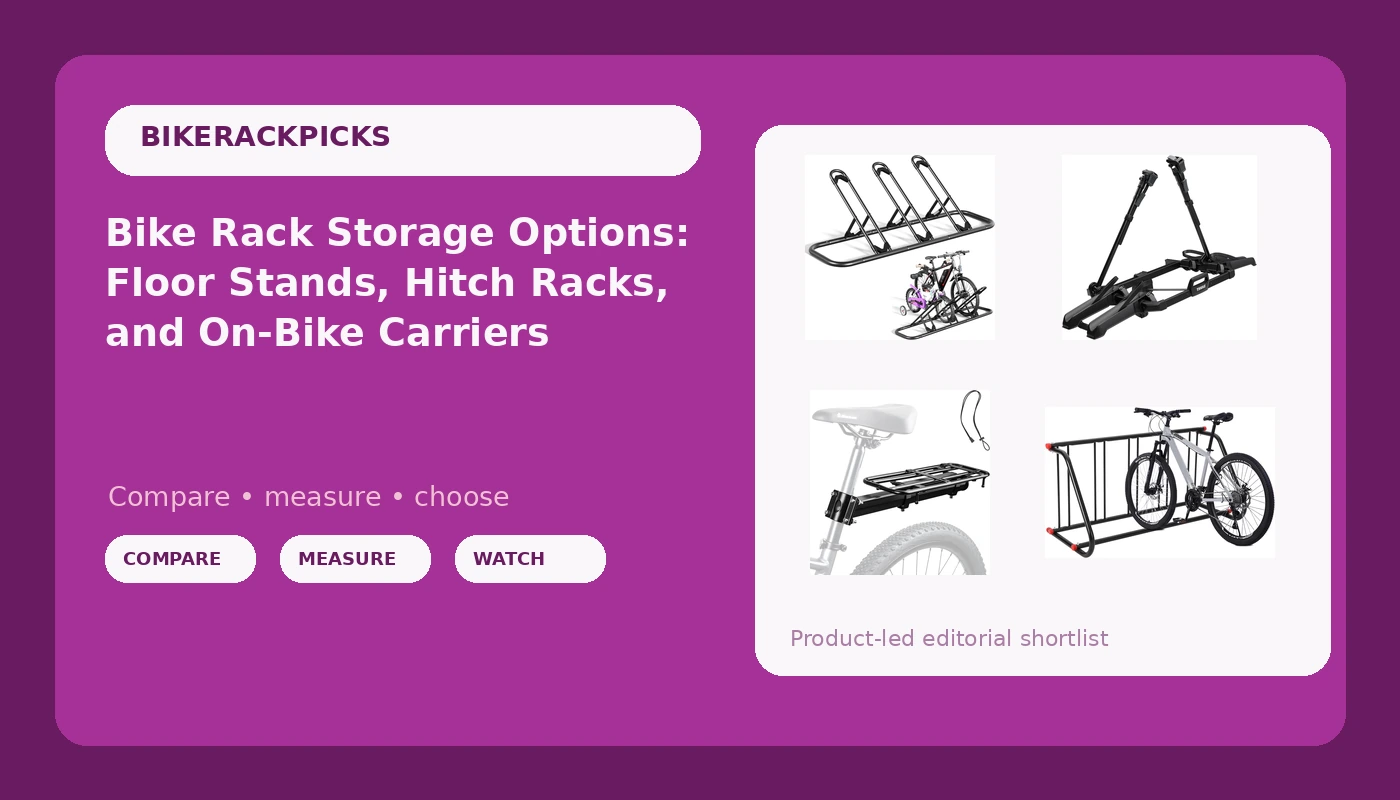
Match the rack to the job before comparing anything else. For carrying bikes on a car, a hitch rack is the correct category, and the Thule Outpace 2 Bike Hitch Rack is built for both 2-inch and 1.25-inch receivers with a 110 lb capacity rating. For keeping bikes upright at home, a floor stand does the work with no hitch involved: the Mr IRONSTONE three-slot stand suits a small garage, while the Commercial Grid stand holds five bicycles for a garage, school, shop, or parking area. For carrying gear on the bike rather than a car, the WEEROCK Adjustable Universal Rear Bike Rack is a seat-post mounted steel carrier rated for 33 lb. None of these is a roof rack, and none should be loaded beyond its stated capacity.
Four useful options
| Model | Best fit | What stands out |
|---|---|---|
| Thule Outpace 2 Bike Hitch Rack | Car travel with one or two bikes | Fits 2-inch and 1.25-inch hitches, 110 lb capacity rating |
| Commercial Grid Bike Rack | Garage, school, shop, or parking area with several bikes | Five-bicycle capacity, single or double sided floor stand |
| Mr IRONSTONE Bike Rack | Small indoor or covered outdoor space | Three slots, fits mountain, road, and kids cycles |
| WEEROCK Adjustable Universal Rear Bike Rack | Carrying gear on the bike itself | Seat-post mount, fits 20 to 29 inch bikes, 33 lb capacity rating |
The travel rack: Thule Outpace 2 Bike Hitch Rack
Two numbers decide whether this rack fits your car: receiver size and total load. The Outpace 2 covers both 2-inch and 1.25-inch hitches, which matters because 1.25-inch receivers are common on crossovers and small SUVs and they limit how much rack you can hang off the back. The 110 lb rating is a total figure, so it has to cover the rack plus both bikes. Two 45 lb mountain bikes plus the rack itself sit close to that ceiling, while two 20 lb road bikes leave plenty of margin. Check the tongue weight rating in your vehicle's owner's manual as well, since the hitch and the car each carry their own limit. A rack that exceeds either number is not a rack problem, it is a liability.
The high-capacity floor rack: Commercial Grid Bike Rack
Grid racks hold bikes by the wheel, which means no lifting and no frame contact. That is why schools, shops, and apartment parking areas use them: a rider rolls the front wheel into a slot and walks away. The five-bicycle capacity and the choice of single or double sided layout let you fit a wall or run a freestanding row down the middle of a space. The trade-off is footprint. Five bikes need real floor area, and a double sided unit needs walking clearance on both sides. In a residential garage, measure the wall or the bay first, then decide whether you want five slots or three. In a commercial setting, plan for anchoring and for the spacing riders actually use when they are in a hurry.
The compact floor stand: Mr IRONSTONE Bike Rack
A three-slot stand is the practical answer for the household that keeps two adult bikes and a kids bike in a one-car garage. Because it holds bikes upright in individual slots, it uses a fraction of the floor area that leaning bikes against a wall requires, and it keeps handlebars and pedals from tangling. The listing covers mountain, road, and kids cycles and indoor or outdoor parking, so it works on a patio or under an overhang as well as inside. The limits are simple: three slots means three bikes, and a stand of this type is not a security device. If theft is a concern, the stand organizes the bikes and a separate lock secures them.
The on-bike carrier: WEEROCK Adjustable Universal Rear Bike Rack
This one is not a car rack and should not be judged like one. It mounts to the seat post and turns the bike itself into the carrier, which is what you want for commuting, errands, or a light bikepacking setup where a backpack gets old fast. It fits 20 through 29 inch wheels, so it covers kids bikes up to full size mountain and road frames, and the 33 lb rating has to include the bag, the lock, and anything else you strap on. Two fit notes matter: a dropper post has to stay in a fixed position while the rack is mounted, and carbon seat posts and carbon frames deserve a careful look at the manufacturer's guidance before you clamp anything to them.
Prices and availability may change. Product images, names, and retailer links are matched to verified listings. No current price, rating, stock status, or measured result is stated here without current evidence.
Floor stands, hitch racks, and on-bike racks are not substitutes
The most common mistake in this category is buying one rack to do all three jobs. It does not work.
A floor stand lives where the bikes live. It never moves, it needs no hitch, and its only job is to keep bikes upright and separated. It solves clutter, and it solves the scratched top tube that comes from leaning a bike against a wall.
A hitch rack lives on the car. It has to handle highway wind loads, which is a completely different engineering problem from holding a bike still in a garage. Receiver size, tongue weight, and total load rating are the numbers that matter, and a 1.25-inch receiver will always be more limited than a 2-inch one.
An on-bike cargo rack lives on the bicycle. It carries gear, not bicycles, and its capacity rating covers the bag and everything in it.
Buy the category that matches the job. If you need two categories, you need two products, and the floor stand is the inexpensive half of that pair.
How to choose in five steps
- Write down where the bikes spend most of their time. If the answer is a garage, basement, or patio, you are shopping for a floor stand and a hitch rack is the wrong purchase.
- If bikes travel by car, find your receiver size before anything else. A 2-inch receiver opens up heavier two-bike racks; a 1.25-inch receiver narrows the field and caps the load.
- Add up the real weight. Two bikes plus the rack has to stay under the rack's capacity rating, and the whole assembly has to stay under your vehicle's tongue weight limit.
- Count bikes twice. A three-slot stand for four bikes means one bike on the floor, and a two-bike hitch rack for three riders means a second trip.
- Decide whether you want to carry bikes or carry gear. If the answer is gear, an on-bike rack belongs on the bicycle, not on the car.
Practical guidance before you order
- Measure the space first. Five-bike floor racks and double sided units need real floor area and walking clearance.
- Confirm the hitch receiver size on the vehicle itself, not on paperwork from a previous car.
- Weigh your heaviest bike with pedals, cages, and a full bottle, then double it and add the rack's own weight.
- Check the vehicle's tongue weight rating in the owner's manual before trusting any rack's capacity number.
- For seat-post racks, check whether the post is carbon or a dropper before you clamp anything to it.
Which option should you choose?
Choose the Thule Outpace 2 Bike Hitch Rack when the bikes need to travel on a car and your receiver is either 2-inch or 1.25-inch. Choose the Commercial Grid Bike Rack when several bikes need to park in one place, whether that is a garage wall, a school, a shop, or an outdoor parking area. Choose the Mr IRONSTONE Bike Rack when you have two or three bikes and limited floor space indoors or on a covered patio. Choose the WEEROCK Adjustable Universal Rear Bike Rack when the goal is carrying gear on the bike rather than carrying bikes on a car.
One caveat: the capacity figures above come from the product listings, and they describe limits rather than performance. Nothing here has been independently measured, and no rack should be loaded past the number on its label.
The bottom line
Start with the job, not the rack. Bikes that live at home need a floor stand, and the Mr IRONSTONE three-slot stand or the five-bike Commercial Grid stand will do that work with no hitch involved. Bikes that travel need a hitch rack, and the Thule Outpace 2 Bike Hitch Rack covers both common receiver sizes with a 110 lb capacity rating. Gear that travels on the bike needs an on-bike carrier, and the WEEROCK rear rack handles that with a 33 lb rating. Check the capacity numbers against your actual bikes and your vehicle's tongue weight, and check current Amazon price before you commit, because rack pricing moves with the season.