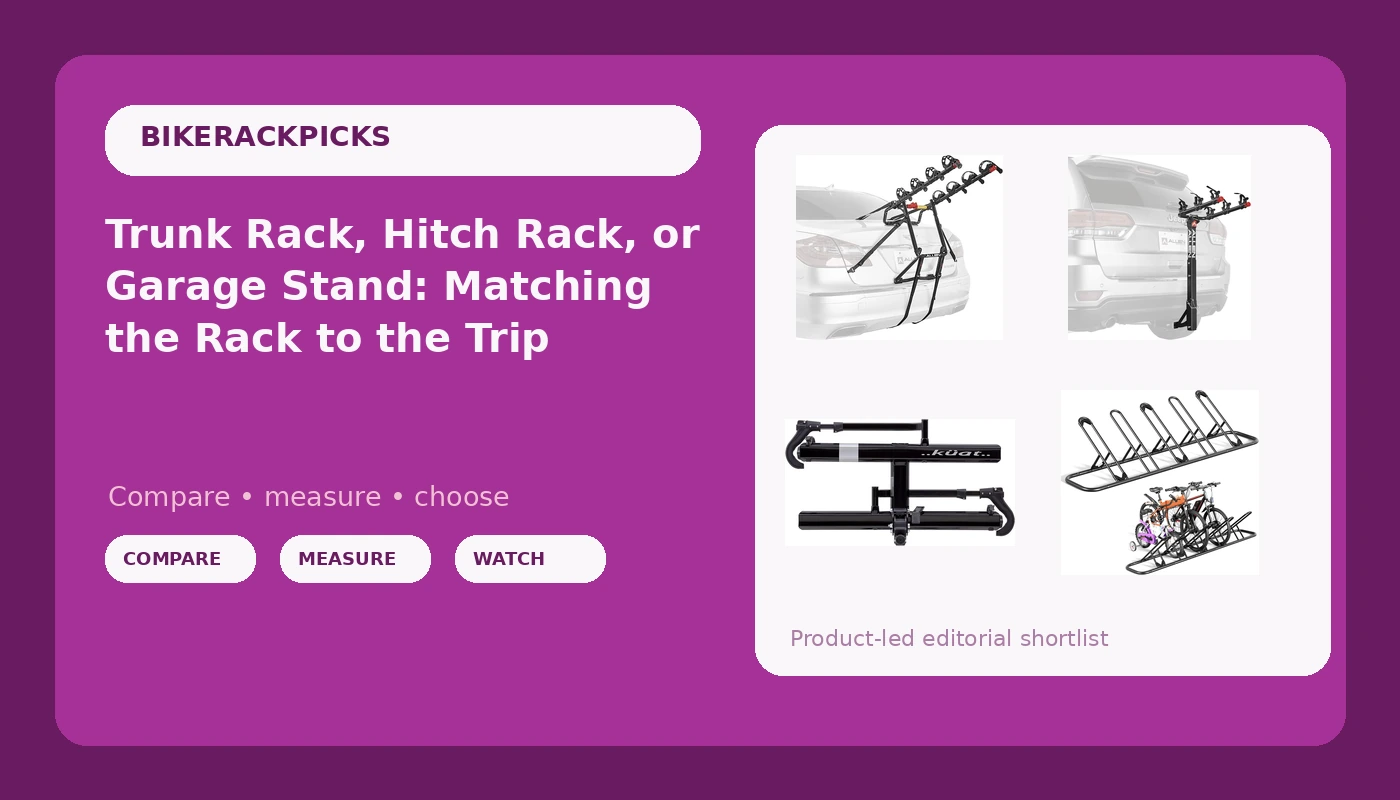
Most people shopping for a bike rack are really answering one question: where does the bike live once it leaves the driveway? That question has three inputs you already know about yourself. How many bikes move at once. What your vehicle actually offers, whether that is a receiver hitch, a hatch, or just a garage wall. And whether the rack's only job is transport, or whether it also has to keep bikes off the floor between rides. This trunk rack vs hitch rack walkthrough covers four options at four very different price points, because the honest answer is that a floor stand and a premium two-bike hitch carrier are not competing for the same dollar. They solve different problems, and mixing them up is how people end up with a rack that rattles, scratches paint, or never gets used at all.
Related: How to Match a Hitch Rack to Your Receiver Class →
Quick answer
Match the rack to the job rather than to a brand name. If you haul bikes a few times a season on a sedan and the bikes are inexpensive, a trunk rack is the low-commitment route. If you haul regularly and your vehicle has a receiver, a hitch rack attaches to the vehicle's frame instead of its body panels, and a rack that lists fitment for both 1 1/4-inch and 2-inch receivers gives you room to change cars later. If you want a compact two-bike carrier, a dedicated two-bike hitch rack earns its keep over years of use. And if the bikes mostly stay home, a floor stand is storage rather than transport, and it is the cheapest way to stop tripping over handlebars in the garage.
4 useful options
| Model | Best fit | What stands out |
|---|---|---|
| Allen Sports Premier 4-Bike Trunk Rack, Model S104, Black | Occasional trips in a sedan or hatchback with no receiver | Four-bike trunk-mounted carrier in the Allen Sports Premier line |
| Allen Sports 3-Bike Hitch Rack for 1 1/4 in. and 2 in. Hitch | Regular hauling on a vehicle with either common receiver size | Three-bike hitch carrier with listed fitment for both receiver sizes |
| Kuat Sherpa 2.0 Compact 2-Bike Transporting Hitch Rack | Two-bike hauling with a smaller footprint | Compact two-bike hitch carrier from the Kuat Sherpa line |
| Mr IRONSTONE Floor Bike Rack, 5-Slot, Black | Garage, basement, or patio storage for a whole household | Freestanding five-slot stand listed for mountain, road, and kids bikes |
Occasional hauling: Allen Sports Premier 4-Bike Trunk Rack, Model S104, Black
The trade-off with any trunk rack is contact. Straps hook to body panels and the rack rests against paint or glass, so the interface between rack and car matters as much as the rack itself. Trunk racks also sit behind the rear glass and can obscure tail lights and license plates depending on the vehicle and how the rack is positioned, which is worth checking against local rules before a long drive. For a short hop to a trailhead with kids' bikes, that is a reasonable compromise. For a carbon road bike doing highway miles every weekend, most riders eventually move to a receiver-mounted rack instead.
The flexible receiver option: Allen Sports 3-Bike Hitch Rack for 1 1/4 in. and 2 in. Hitch
Dual-size fitment is a bigger deal than it sounds. Receiver size is not cosmetic: a 1 1/4-inch receiver is physically smaller and typically rated for less tongue weight than a 2-inch receiver, and a rack that only fits one size becomes useless the moment you change vehicles. A rack listed for both sizes travels with you across a car upgrade. The catch is that hitch racks vary in how they carry bikes, whether by the frame or by the wheels, so look at the listing photos and instructions before you assume a particular loading style. Capacity numbers are also vehicle-dependent. Three bikes on the rack still has to stay inside your hitch's tongue weight rating and your vehicle's own limits.
The compact premium carrier: Kuat Sherpa 2.0 Compact 2-Bike Transporting Hitch Rack
The case for spending more here is not prestige, it is the daily workflow. A rack you can mount quickly gets used; a rack that takes half an hour to wrestle into place gets left in the garage. Premium racks also tend to carry better hardware, better anti-sway provisions, and better lock options, all of which matter more once you are hauling bikes that cost more than the rack. What you give up is capacity. Two bikes is two bikes, and if the household grows to four riders, this is the wrong purchase. Buy it because two is your real number, not because you hope to talk yourself into it.
Storage that ends the pile-up: Mr IRONSTONE Floor Bike Rack, 5-Slot, Black
A floor stand solves the problem that creates most rack purchases in the first place: bikes leaning on each other, on walls, and on cars. Keeping five bikes upright in one footprint also means the bike you want is the bike you can reach, which shortens the gap between deciding to ride and actually riding. Because it is freestanding, it works in a rental garage where drilling into a stud is not an option, and it can move outdoors when the weather is fine. Just remember what it is not: it does not go on a car, and no storage rack should be confused with a transport rack when you are planning a trip.
Prices and availability may change. Product images, names, and retailer links are matched to verified listings. No current price, rating, stock status, or measured result is stated here without current evidence.
Hitch class, receiver size, and what your vehicle can actually carry
Before you compare racks, read the sticker on your hitch and the towing section of your owner's manual. Receivers come in common sizes, most often 1 1/4-inch and 2-inch, and the size is tied to the hitch class. A 1 1/4-inch receiver is usually a lighter-duty Class I or II setup, while 2-inch receivers are typical of Class III and up. The important number is not the class label itself but the tongue weight rating, which is how much downward load the hitch and the vehicle structure are rated to carry. A loaded bike rack is a cantilevered load hanging off the back of the car, well behind the rear axle, and it counts against that rating.
That is why a rack that claims to hold four bikes is not automatically appropriate for every vehicle that can physically accept it. Four bikes plus the rack can add up quickly, and every pound sits behind the rear axle where it also affects steering and braking feel. It is also why 2-inch receivers are the de facto standard in the rack world: more capacity, less flex, and far more rack options. If you are buying a hitch specifically to carry bikes, the receiver size you choose now determines what you can buy later. The Allen Sports hitch carrier here is listed for both common sizes, which makes it a sensible bridge if you are not sure what your next vehicle will have.
How the different rack designs carry a bike
Trunk racks support the bikes against the vehicle body using straps and contact points. They need no hitch, they fold away for storage, and they are the least expensive way to move a bike. In exchange, the load rests against paint and glass, the bikes hang close together, and the whole assembly sits behind the rear of the car where it can block lights and camera views.
Hitch racks mount to a receiver, which is a structural attachment point rather than a body panel. Within that family, designs differ. Some carry bikes hanging from the frame, which is fast to load and works well for heavier, durable bikes. Others support the wheels, which avoids frame contact entirely and is the reason riders on carbon frames tend to prefer them. The rack's own hardware, its anti-sway provisions, and how it secures wheels or frames vary widely, so the loading style is something to confirm per model rather than assume from the category.
Floor stands are a third thing entirely. They hold bikes upright in a fixed location and never touch a vehicle. For a household with five bikes and a two-car garage, a stand often does more for daily riding than any car rack, because it removes the friction of untangling bikes before every ride.
- Count how many bikes actually travel at once, not how many you own.
- Check whether your vehicle has a receiver, and if so, measure the opening and read the tongue weight rating.
- Decide how often you haul. A few times a year and regular weekend trips lead to different purchases.
- Note what the bikes are made of. Frame contact is a bigger concern on carbon than on aluminum.
- Decide whether you also need storage at home, since that is a separate purchase with a separate job.
Loading, securing, and living with a rack
- Confirm the rack's stated capacity and receiver fitment against your own vehicle before ordering, not after.
- Keep total rack and bike weight inside your hitch's tongue weight rating, and check the vehicle's own limits as well.
- Use the rack's wheel or frame retention as designed, and recheck straps and hardware after the first few miles of any trip.
- Watch what the loaded rack does to your rear lights, plate, and backup camera, and reposition if anything is obscured.
- Plan for the empty-rack state too. A rack that folds or tilts out of the way is easier to live with in parking lots and garages.
Which option should you choose?
Choose the Allen Sports Premier 4-Bike Trunk Rack, Model S104, Black when you have no receiver, you haul a few times a season, and the bikes are inexpensive enough that strap-mounted carrying is an acceptable trade. Choose the Allen Sports 3-Bike Hitch Rack for 1 1/4 in. and 2 in. Hitch when you haul regularly and want one carrier that fits either common receiver size. Choose the Kuat Sherpa 2.0 Compact 2-Bike Transporting Hitch Rack when two bikes is your real number and you would rather buy a compact, purpose-built carrier once. Choose the Mr IRONSTONE Floor Bike Rack, 5-Slot, Black when the bikes spend most of their time at home and the daily problem is a garage floor full of tangled handlebars.
One caveat applies to all four: nothing here replaces reading your vehicle's ratings and the rack's own instructions. Capacity claims, tongue weight limits, and fitment details are specific to your car, your hitch, and your bikes, and those are the numbers that decide whether a setup is appropriate. No price, rating, or measured performance figure is stated here, because those change constantly and should be checked on the live listing.
The bottom line
The rack decision is really a vehicle decision and a habit decision. If there is no receiver, a trunk rack is the entry point, with the honest understanding that it contacts paint and suits occasional trips. If there is a receiver, a hitch rack is the more structurally sound attachment, and one that fits both 1 1/4-inch and 2-inch receivers protects you against a future car change. If two bikes is genuinely your limit, a compact two-bike hitch carrier is the cleaner long-term buy. And if the real bottleneck is a crowded garage rather than a crowded car, a five-slot floor stand fixes the problem that sends most people shopping in the first place. Pick the one that matches how you actually ride, then verify fitment and current pricing on the listing before you commit.