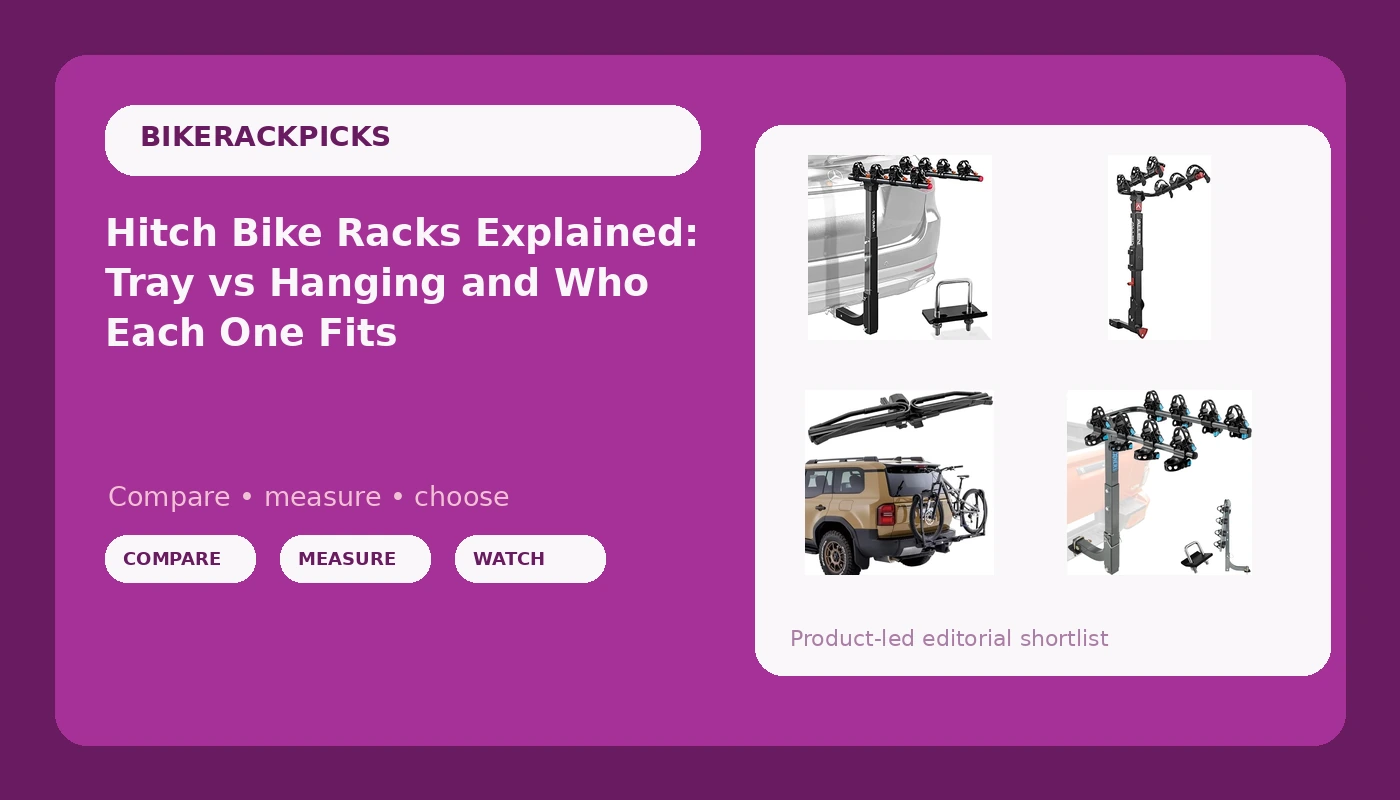
A hitch mount bike rack is safety equipment, not cargo gear. That is the frame I use for every rack question, because the failure mode is not a scratched bumper. It is a bike leaving the car at highway speed. The difference between a rack that holds and a rack that lets go usually comes down to design choices you can read before you buy: how the bike is supported, what your hitch can legally carry, and whether the rack is rated for the bikes you actually own.
I have owned eight racks in twelve years, including a trunk strap rack that scratched paint and a hanging rack that swung into a divider. The good news is that the four racks below cover the realistic choices for a hitch-mounted setup, and none of them requires you to guess. What follows is the design logic, the numbers that decide the purchase, and the specific situations where each one makes sense.
Related: Hitch class explained: 1.25-inch vs 2-inch receivers →
Quick answer
Drivers with a 2-inch receiver and expensive, heavy, or carbon bikes should buy a platform or tire-hold rack, because the bike is supported at the wheels and cannot swing into its neighbor. Drivers who need to move three or four bikes on a tighter budget should buy a hanging rack with cradles and a 2-inch hitch, then match the rack's stated capacity to the combined weight of the bikes with margin left over. If your hitch is 1 1/4 inches, plan on two bikes as a working limit, and treat the Allen Sports 3-bike rack as the flexible exception that fits both receiver sizes.
Four useful options
| Model | Best fit | What stands out |
|---|---|---|
| 4 Bike Rack Hitch Mount (240lbs Capacity), Bike Rack for Car Made with Heavy-Duty Steel, Dual Cradle Systems, Bicycle Carrier for Car, SUV, Truck 2” Receiver | Four bikes on a 2-inch hitch | Stated 240 lb capacity with dual cradle systems on a heavy-duty steel frame |
| IKURAM R 4 Bike Rack Bicycle Carrier Racks Hitch Mount Double Foldable Rack for Cars, Trucks, SUV's and minivans with a 2" Hitch Receiver | Four bikes, with a rack that folds away | Double-foldable design that tucks toward the vehicle when empty |
| Allen Sports 3-Bike Hitch Racks for 1 1/4 in. and 2 in. Hitch | Three bikes across mixed vehicles | Fits both 1 1/4-inch and 2-inch hitch receivers |
| INNO INH110 Tire Hold Hitch Mount (1.25"/2") Platform Rack (1) Bike (E-Bike, Fat Tire, Full Suspension, Carbon Compatible) | One heavy, odd, or carbon bike | Tire-hold platform listed as e-bike, fat tire, full suspension, and carbon compatible |
The high-capacity value pick: 4 Bike Rack Hitch Mount (240lbs Capacity), Bike Rack for Car Made with Heavy-Duty Steel, Dual Cradle Systems, Bicycle Carrier for Car, SUV, Truck 2” Receiver
Capacity is the entire story with a rack like this. Four bikes on a hanging rack means four frames resting on two arms, and those arms carry the combined weight of the bikes plus the leverage of a load sitting out behind the hitch. The stated 240 lb figure leaves room for four typical adult bikes, but it is not unlimited. Four e-bikes or four downhill bikes will eat that budget quickly, so add up your own bike weights before assuming you are inside the limit. The trade-off with a steel rack at this capacity is weight and bulk. It is not the rack you leave mounted all year for the look of it, and folding it away when empty takes a moment. What you get in return is a straightforward, high-capacity carrier that leaves room in the budget for a locking hitch pin and a cable lock.
The folding four-bike option: IKURAM R 4 Bike Rack Bicycle Carrier Racks Hitch Mount Double Foldable Rack for Cars, Trucks, SUV's and minivans with a 2" Hitch Receiver
Hanging racks earn their reputation in two ways: they are cheap per bike carried, and they let the bikes swing. A folding design does not change that physics, it just makes the rack easier to live with when you are not hauling. Folding earns a place on the priority list for a simple reason: a rack that takes extra minutes to remove gets left in the garage, and a rack that folds flat gets used on the Tuesday night group ride as well as the weekend trip. If you go this route, budget for an anti-sway device or a strap between the bikes, because four frames on two arms will touch on a rough road. Note the hitch requirement too. This one will not mount to a 1 1/4-inch receiver, so check your hitch before you commit.
The three-bike crossover: Allen Sports 3-Bike Hitch Racks for 1 1/4 in. and 2 in. Hitch
The dual receiver fit is the practical feature here. Households with a small crossover and a truck, or a rider who is about to change cars, get one rack that works on both instead of buying twice. Three bikes is also the sweet spot for a lot of families: two adult bikes and a kid's bike, or three road bikes for a weekend away. Two things to weigh before you decide. First, a rack that also fits a 1 1/4-inch hitch is designed around the lower capacity of that receiver class, so on a 2-inch hitch you are still carrying three bikes and no more. Second, hanging racks in this segment typically rely on cradle straps and a basic anti-sway setup, so plan on adding a locking hitch pin and a way to keep the outermost bike from moving. For a mixed fleet of ordinary aluminum bikes, that is a fair trade for the flexibility.
The one-bike platform rack: INNO INH110 Tire Hold Hitch Mount (1.25"/2") Platform Rack (1) Bike (E-Bike, Fat Tire, Full Suspension, Carbon Compatible)
Tire-hold platforms solve the two problems hanging racks cannot: frames that should not be clamped or hung, and bikes that are too heavy or too oddly shaped to sit in a cradle. A carbon road frame is the obvious case, and so is a full-suspension mountain bike whose rear triangle does not want to rest on an arm. The trade-off is capacity. This rack carries one bike, so a two-rider household needs two racks or a different design, and the cost per bike is high compared with a four-bike hanging rack. If your bikes are worth more than your car's deductible, that math flips quickly. Check the rack's stated weight limit against your bike before you buy, especially with an e-bike, and confirm the tire and wheel size range covers what you ride.
Prices and availability may change. Product images, names, and retailer links are matched to verified listings. No current price, rating, stock status, or measured result is stated here without current evidence.
Tray racks and hanging racks: the design difference that decides everything
A hanging rack suspends the bikes from arms. The bikes rest on cradles, usually by the top tube or by straps over the frame, and the whole load hangs in the air behind the vehicle. Hanging racks are the cheapest way to carry a lot of bikes, they fold small, and they work well for ordinary aluminum hybrids, cruisers, and kids' bikes.
A platform rack supports the bike from below, either in wheel trays or by gripping the tire. The frame is never loaded, which is why platform designs are the ones that carry a carbon frame, a full-suspension mountain bike, a fat bike, or an e-bike. The catch is cost per bike. A four-bike platform rack is a serious purchase, while a four-bike hanging rack is not.
Three details separate good hanging racks from bad ones: anti-sway hardware that keeps frames from rubbing, cradle straps that hold the bike down rather than just around, and a mast that folds or tilts. On the platform side, the details that matter are the wheel tray width, the tire strap, and whether the rack tilts away from the hatch when a bike is loaded. A rack that tilts only when empty is a rack that never tilts.
Hitch class, tongue weight, and the numbers that decide your rack
Receiver size is not the same thing as hitch class, and the class is what sets your limit. A 1 1/4-inch receiver is usually a Class I or Class II hitch with a low tongue weight rating, which is the downward force the hitch is designed to carry. A 2-inch receiver is often a Class III or Class IV with a much higher rating. Your owner's manual is the only authority here, and it may rate a 2-inch receiver lower than you expect.
The rack, the bikes, and the leverage all count against that tongue weight rating. A rack hanging two feet behind the hitch puts more effective load on the hitch than the same weight sitting on the ball, and hitch extenders and adapters reduce capacity further. The rule that saves you: the lower of the two numbers wins. If the rack says 240 lb and your hitch says 200 lb of tongue weight, and the rack itself weighs 40 lb, you have about 160 lb of bike capacity, which is roughly three adult bikes and not four.
A five-step way to choose
- Read your hitch. Find the receiver size, the class, and the tongue weight rating in the owner's manual or on the hitch label.
- Weigh your bikes. A bathroom scale and a simple lift-and-stand method gets you close enough, then add the rack's own weight.
- Count the bikes you carry on a normal weekend, not the maximum you can imagine hauling once a year.
- Rule out hanging racks if any bike is carbon, an e-bike, a fat bike, or full suspension. Those four categories belong on a platform.
- Check the small things: folding for storage, tilt for hatch access with bikes loaded, anti-sway, a locking hitch pin, and whether the rack blocks your backup camera or license plate.
Practical guidance for living with a hitch rack
- Keep the combined weight under both the rack's stated capacity and your hitch's tongue weight rating, with margin left over.
- Use a locking hitch pin. Racks are stolen from trailheads and apartment lots.
- Recheck the hitch bolt after the first drive, and again before a long trip. A loose rack is a wobbling rack.
- Use an anti-sway strap or device on any hanging rack, and check cradle straps before every departure.
- Remove the rack before an automatic car wash, and inspect straps and bolts at the start of each season.
Which option should you choose?
Choose the 4 Bike Rack Hitch Mount (240lbs Capacity), Bike Rack for Car Made with Heavy-Duty Steel, Dual Cradle Systems, Bicycle Carrier for Car, SUV, Truck 2” Receiver when you need four-bike capacity on a 2-inch hitch and you want the lowest cost per bike carried. Choose the IKURAM R 4 Bike Rack Bicycle Carrier Racks Hitch Mount Double Foldable Rack for Cars, Trucks, SUV's and minivans with a 2" Hitch Receiver when you want that same four-bike capacity but you need the rack to fold out of the way when it is empty. Choose the Allen Sports 3-Bike Hitch Racks for 1 1/4 in. and 2 in. Hitch when you move between a 1 1/4-inch and a 2-inch hitch, or when three bikes is genuinely all you ever carry. Choose the INNO INH110 Tire Hold Hitch Mount (1.25"/2") Platform Rack (1) Bike (E-Bike, Fat Tire, Full Suspension, Carbon Compatible) when you carry one bike that should never hang.
Capacity figures quoted above are the manufacturers' stated numbers, not measurements, and they vary by bike weight, wheelbase, and hitch rating. Two riders with the same rack and the same number of bikes can have very different margins depending on what those bikes weigh. Verify your own hitch rating and your own bike weights before you load up, and never exceed the smaller of the two limits.
The bottom line
The rack you should buy is decided by two questions: does your bike have a frame that can hang, and what does your hitch actually allow? If the answer to the first is no, the INNO INH110 is the straightforward path, one bike at a time, frame untouched. If the answer is yes and you need to move a full set of bikes, the hanging racks here split on convenience and fit: the steel 240 lb rack for maximum capacity per dollar, the IKURAM R for the same capacity with a folding frame, and the Allen Sports 3-bike for the rider who needs one rack that works on both receiver sizes. Add a locking hitch pin, add an anti-sway strap, and do the weight math before the first trip. That is what separates a rack that works from a rack that ruins a weekend.