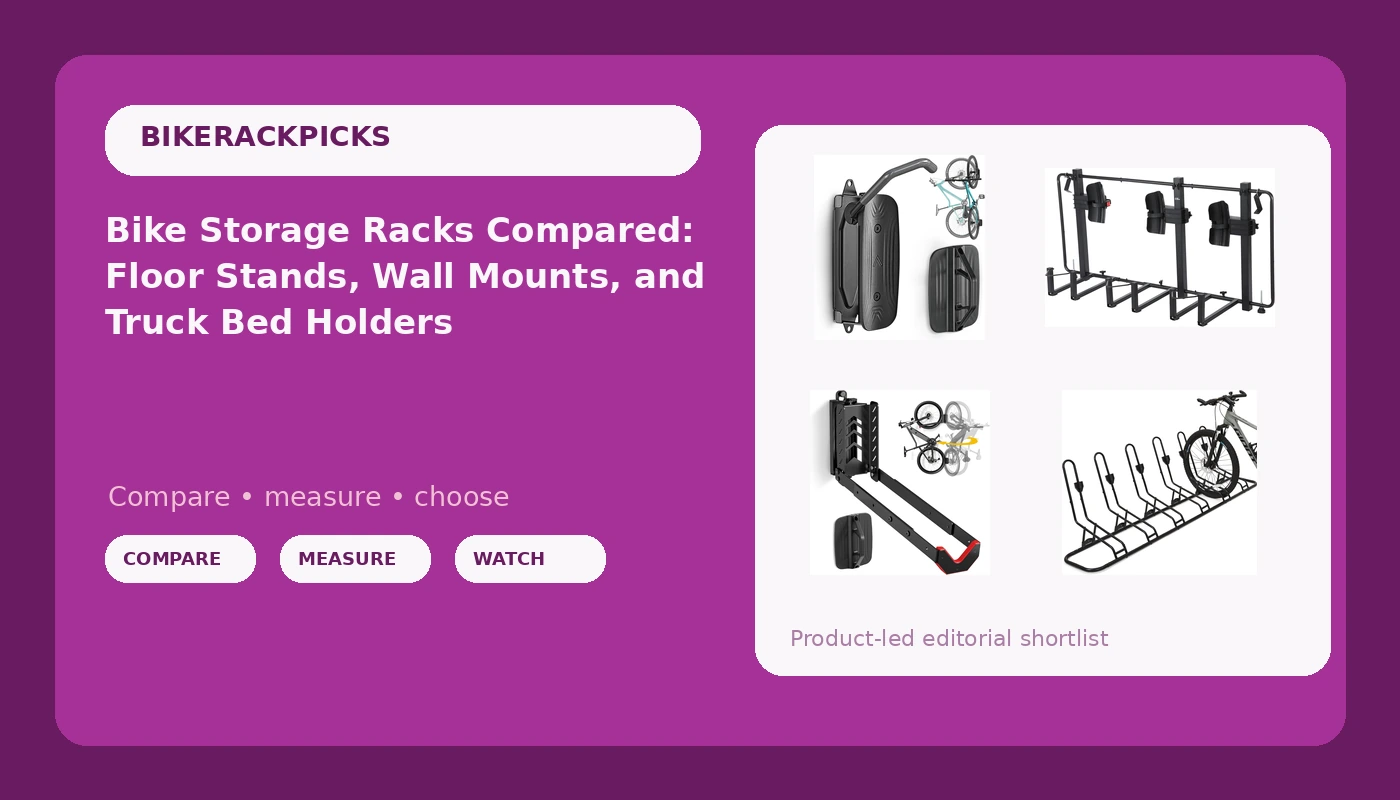
Most riders do not have a bike storage problem so much as a bike placement problem: four bikes leaning against the same garage wall, a floor pump wedged behind a crank arm, and a helmet that has to be moved before anything rolls out the door. Garage bike storage racks fix that specific mess, and the four options below fix it in four different ways. One is a free-standing floor stand that corrals a whole family of bikes. Two are wall mounts that get wheels off the concrete. One is a bed-mounted carrier for the days the bikes travel in the truck instead of on a hitch.
The useful question is not which rack is the most capable. It is which rack matches the space you actually have, the bikes you actually own, and how often those bikes leave the garage.
Related: How to Fit Four Bikes in a Two-Car Garage →
Quick answer
Start with where the bikes live. If you have open floor and a mixed fleet, a free-standing floor rack that holds several bikes keeps everything upright and movable without drilling a single hole. If floor space is the scarce resource and the bikes are light enough to lift, a swivel wall mount gives you the smallest footprint per bike. If the bikes travel in a pickup bed, a bed-mounted carrier keeps the load inside the truck and removes the hitch from the equation entirely. Tire width, bike weight, ceiling height, and how often the bikes move settle the rest.
Four useful options
| Model | Best fit | What stands out |
|---|---|---|
| Floor Bike Rack for 6 Bikes | Garages and shared spaces with several bikes and open floor | Free-standing design for up to six bikes, built to safeguard disc brakes and derailleurs, waterproof, fits 12 to 29 inch tires |
| monTEK Swivel Bike Wall Mount | Riders who want the smallest footprint per bike | Vertical wall mount with a swivel arm, one pack, gray finish |
| JOYTUTUS 3-Bike Truck Bed Bike Rack | Full size pickup owners hauling up to three bikes | Bed-mounted carrier with an anti-wobble design and no wheel removal |
| monTEK No-Lift Swivel Bike Wall Mount | Riders who would rather not lift a bike overhead | No-lift wall mount with a swivel arm, one pack |
Floor anchor for a full garage: Floor Bike Rack for 6 Bikes
Floor stands are the least fussy category in bike storage. Nothing gets drilled, nothing gets lifted, and the whole rack can move to a different wall when the garage gets reorganized for winter. The trade-off is footprint. A six-bike stand occupies a strip of floor roughly the length of a small car, and in a two-car garage that strip is often exactly what you were trying to reclaim. The contact design here is aimed at keeping pressure off rotors and derailleurs, which matters on a fleet with hydraulic discs, and the waterproof build means it can live on a covered patio rather than only in a dry garage. Tire coverage from 12 to 29 inches lets kids' bikes share the same rack as adult bikes. If your floor is already committed to a car or a workbench, this solves a problem you do not have.
Cheapest way to clear floor space: monTEK Swivel Bike Wall Mount
A swivel wall mount is the most storage per square foot you can get without touching the ceiling, and it is the reason a two-bike household can park two cars in a two-car garage. The catch is that one mount holds one bike, so four bikes means four mounts and four stud bays or a wall of added blocking. Vertical hanging also puts the bike at shoulder height or above, which is fine for a 17-pound road bike and considerably less fine for anything with a motor. Check ceiling height before committing, since a vertical hang needs the full length of the bike plus clearance for the hook and the front wheel. Mounting into a stud or proper blocking is not optional here. Drywall anchors alone are not a plan for a bike hanging above a car.
Pickup bed solution: JOYTUTUS 3-Bike Truck Bed Bike Rack
Truck bed carriers sit in a different conversation than hitch racks. The bike stays inside the footprint of the truck, the front wheel typically hangs over the tailgate on a pad or strap, and nothing dangles off the rear bumper where a tight parking lot or a crowded trailhead can find it. The anti-wobble design is the part worth attention, because a bed rack that shifts side to side turns three bikes into a tangle of handlebars, pedals, and brake levers by the time you reach the trailhead. No wheel removal is the other practical win: the bike rolls in and rolls out, which is the difference between a two-minute load and a fifteen-minute one. This rack is sized for a full size pickup bed, so a compact or short-bed truck is a separate fit question.
No overhead lift: monTEK No-Lift Swivel Bike Wall Mount
No-lift wall mounts exist because the lift-and-hang routine is the main reason wall racks get abandoned. Instead of pressing a bike overhead onto a hook, the bike rolls in at ground level and the arm pivots it into the stored position. That removes the awkward part of hanging a bike: the moment when you are holding 25 pounds above your head, balanced on one foot, hoping the rear wheel finds the hook. It helps heavier bikes, riders with shorter reach, and anyone loading in the dark after a long ride. Compared with a basic swivel hook, the trade-off is cost. Compared with a floor stand, the trade-off is still one bike per mount, plus the same stud or blocking requirement.
Prices and availability may change. Product images, names, and retailer links are matched to verified listings. No current price, rating, stock status, or measured result is stated here without current evidence.
Match the rack to the space, not the bike count
The most common storage mistake is buying capacity instead of fit. A six-bike stand sounds generous until it is parked in the middle of a one-car garage, and a wall full of hooks sounds efficient until half of them are above a shelf you cannot reach. Measure first: the length of open floor along the wall, the wall height to the ceiling, and the width of the narrowest point the bike has to pass through to reach the rack.
Then think about weight and reach. A vertical hang requires lifting the bike, so a lighter road or gravel bike is a much easier candidate than a commuter with a rack, fenders, and a lock bolted on. A no-lift arm reduces that effort but does not change what the mount is rated to hold, and that rating is the number to check before anything goes on the wall.
Finally, think about weather. A waterproof stand can live outdoors or on a covered patio, which is a real advantage in a wet climate, but any rack that leaves a bike outside still leaves the drivetrain and brake surfaces exposed. Storage and protection are two separate jobs.
What separates a rack that gets used from one that does not
Loading speed decides everything. A rack that takes thirty seconds gets used every day. A rack that takes five minutes gets used until the novelty wears off, and then the bikes go back to leaning against the wall.
Footprint matters just as much, because storage that blocks the space you needed it for is not storage. That is the core argument for wall mounts over floor stands, and the core argument for floor stands when the wall is already full of shelving.
Tire width is the quiet failure point. A rack rated for 12 to 29 inch tires covers a wide range, but fat bikes and some plus-size setups sit outside that window, and a rack that cannot hold the tire securely is not a rack you want holding a bike above a car.
Hardware is the third variable. Wall mounts need studs or blocking. Floor stands need level ground. Truck bed racks need a bed long enough to leave the bikes clear of the cab.
- Count the bikes that actually live in the space, not the bikes you own.
- Measure the open floor strip, the usable wall, and the ceiling height above any vertical hang.
- Check tire widths and bike weights against what the rack states it fits and holds.
- Decide how often the bikes move, since daily riders need fast loading and seasonal bikes need compact storage.
- Plan the mounting hardware before you buy: studs or blocking for wall mounts, level ground for a floor stand, bed length for a truck rack.
Setup and safety notes that apply to all four
- Keep the loaded rack clear of taillights, license plates, and the backup camera's line of sight.
- Load the heaviest bike closest to the wall or the cab so the rack is not fighting a lever arm.
- Secure the front wheel on any vertical hang so it cannot flop into the frame or the wall.
- Recheck fasteners after the first few uses and again at the start of each season.
- Store bikes dry where possible, since even a waterproof stand leaves drivetrains exposed to rain.
Which option should you choose?
Choose the Floor Bike Rack for 6 Bikes when you have open floor, several bikes of different sizes, and no interest in drilling into a wall. Choose the monTEK Swivel Bike Wall Mount when floor space is the constraint and the bike going up is light enough to lift by hand. Choose the JOYTUTUS 3-Bike Truck Bed Bike Rack when the bikes travel in a full size pickup bed and you want them inside the truck rather than hanging off a hitch. Choose the monTEK No-Lift Swivel Bike Wall Mount when you want wall storage but would rather not press a bike overhead to get it there.
The caveat is that none of these four is a hitch rack, and none of them is designed to carry bikes at highway speed on the back of a car. They are storage and in-bed transport solutions. If your question is how to carry four bikes on a 2-inch hitch at 75 mph, that is a different article and a different set of safety requirements.
The bottom line
The right rack is the one that matches your space, your tires, and your loading routine. A free-standing six-bike floor stand handles a mixed fleet with zero drilling. A swivel wall mount buys the most storage per square foot for a single light bike. A no-lift wall mount removes the overhead press that makes hanging racks get abandoned. A truck bed carrier keeps three bikes inside a full size pickup with no wheel removal and an anti-wobble design. Pick the one that fits the space you have, mount it into something solid, and check the hardware once a season.